
Walk down the pet supplement aisle and you'll find an overwhelming array of vitamins, minerals and nutritional supplements for dogs. It's enough to make any owner feel like they're probably doing something wrong. But is it all necessary? Does every dog really need a multivitamin?
The honest answer is: not necessarily, but more dogs than you might expect do have nutritional gaps — and those gaps often show up in ways that owners don't immediately connect to nutrition.
In this guide, we'll walk through the seven most common signs that a dog may be falling short nutritionally, explain why those gaps occur even in dogs eating "complete" commercial food, and help you understand what a good multivitamin supplement can and can't do.
Why "Complete and Balanced" Doesn't Always Mean Complete for Your Dog
Most commercial dog foods sold in the UK are formulated to meet the minimum nutritional standards set by FEDIAF, the European Pet Food Industry federation. That's genuinely reassuring — it means the basics are covered. But "meeting minimum standards" and "providing optimal nutrition for your individual dog" are two different things.
Several factors can create nutritional gaps even in dogs eating good-quality commercial food:
- Processing and storage — heat processing during manufacture and prolonged storage can degrade heat-sensitive vitamins (particularly B vitamins and vitamin C)
- Individual variation — just as humans have different nutritional needs at different life stages and under different circumstances, dogs do too
- Health conditions and medications — certain health conditions affect nutrient absorption, and some medications can deplete specific nutrients
- Life stage and activity level — the nutritional needs of an active working dog, a growing puppy and a sedentary senior dog are quite different
- Homemade or raw diets — dogs fed homemade diets are at particular risk of nutritional imbalances, even with the best intentions, unless the diet has been formulated by a veterinary nutritionist
None of this means that commercial dog food is bad — it means that for some dogs, in some circumstances, there's value in a little additional nutritional support.
7 Signs Your Dog Might Benefit From a Multivitamin
1. A Dull, Rough or Lacklustre Coat
A healthy dog should have a coat that's soft, shiny and smooth to the touch. When a coat looks dull, feels rough or coarse, or lacks the shine it used to have, it's often one of the first signs of nutritional insufficiency. Omega-3 fatty acids, biotin, zinc and vitamins A and E all play important roles in coat quality. If you've ruled out skin conditions and your dog's coat still looks lacklustre, nutrition is a logical place to look.
2. Low Energy or Lethargy
Every dog has different energy levels, and some are naturally more laid-back than others. But if your dog seems noticeably more tired than usual — less interested in walks, less eager to play, slow to respond — and you've ruled out medical causes with your vet, B vitamin deficiencies and inadequate mineral intake can be contributing factors. B vitamins are essential for energy metabolism, and a range of minerals support cellular energy production.
3. Frequent Illness or Slow Recovery
A well-nourished dog has a robust immune system. If your dog seems to pick up every bug going, gets frequent mild infections, or takes longer than expected to recover from illness or injury, their immune defence system may not be working at full capacity. Vitamins C, D and E, along with zinc and selenium, are all critical for immune function. Interestingly, dogs can produce their own vitamin C — but under conditions of stress or illness, their requirements may exceed what they can synthesise.
4. Flaky Skin or Excessive Shedding
Beyond coat quality, the skin itself can show nutritional signals. Persistent flakiness, dandruff-like scaling, or excessively dry skin that isn't explained by allergies or external conditions may point to insufficient intake of skin-supporting nutrients. Omega-3 fatty acids are the most notable here, but zinc, vitamin A and biotin are also closely involved in maintaining healthy skin barrier function.
5. Digestive Irregularity
We covered gut health in detail in our guide to the canine microbiome — but it's worth noting here that B vitamins and certain minerals play an important role in digestive enzyme production and gut motility. Dogs with persistent loose stools, inconsistent bowel habits or obvious digestive sensitivity may benefit from broader nutritional support alongside targeted probiotic care.
6. Slow Wound Healing
Skin and tissue repair requires a steady supply of specific nutrients — particularly vitamin C, zinc and protein. If you notice that minor cuts, grazes or skin irritations take longer to heal than you'd expect, nutritional support for tissue repair is worth considering. This is particularly relevant for senior dogs, whose healing capacity naturally reduces with age and who may have more variable nutrient absorption.
7. They're a Puppy, Senior Dog, or Going Through a High-Demand Life Stage
Puppies are building every system in their bodies simultaneously — immune function, bones, muscles, brain, gut — and their nutritional requirements are proportionally very high. Senior dogs often absorb nutrients less efficiently and have different requirements for joint support, cognitive function and immune health. Pregnant or lactating dogs, working dogs in high-demand roles, and dogs recovering from illness all have elevated nutritional needs that their regular food may not fully address.
For dogs at these life stages in particular, a well-formulated multivitamin can provide a meaningful safety net.
What Should a Good Dog Multivitamin Contain?
Not all multivitamins are created equal. When evaluating a supplement for your dog, look for:
- A comprehensive B vitamin complex — B1, B2, B3, B5, B6, B7 (biotin), B9 (folate) and B12 are all involved in energy, nervous system function and cell health
- Vitamins A, C, D and E — the fat-soluble vitamins (A, D, E) and vitamin C are essential for immune function, vision, skin health and antioxidant protection
- Key minerals — zinc, selenium, iron, manganese and copper are all important for various physiological processes
- Omega-3 fatty acids — for skin, coat, brain and cardiovascular health
- No unnecessary fillers or artificial additives
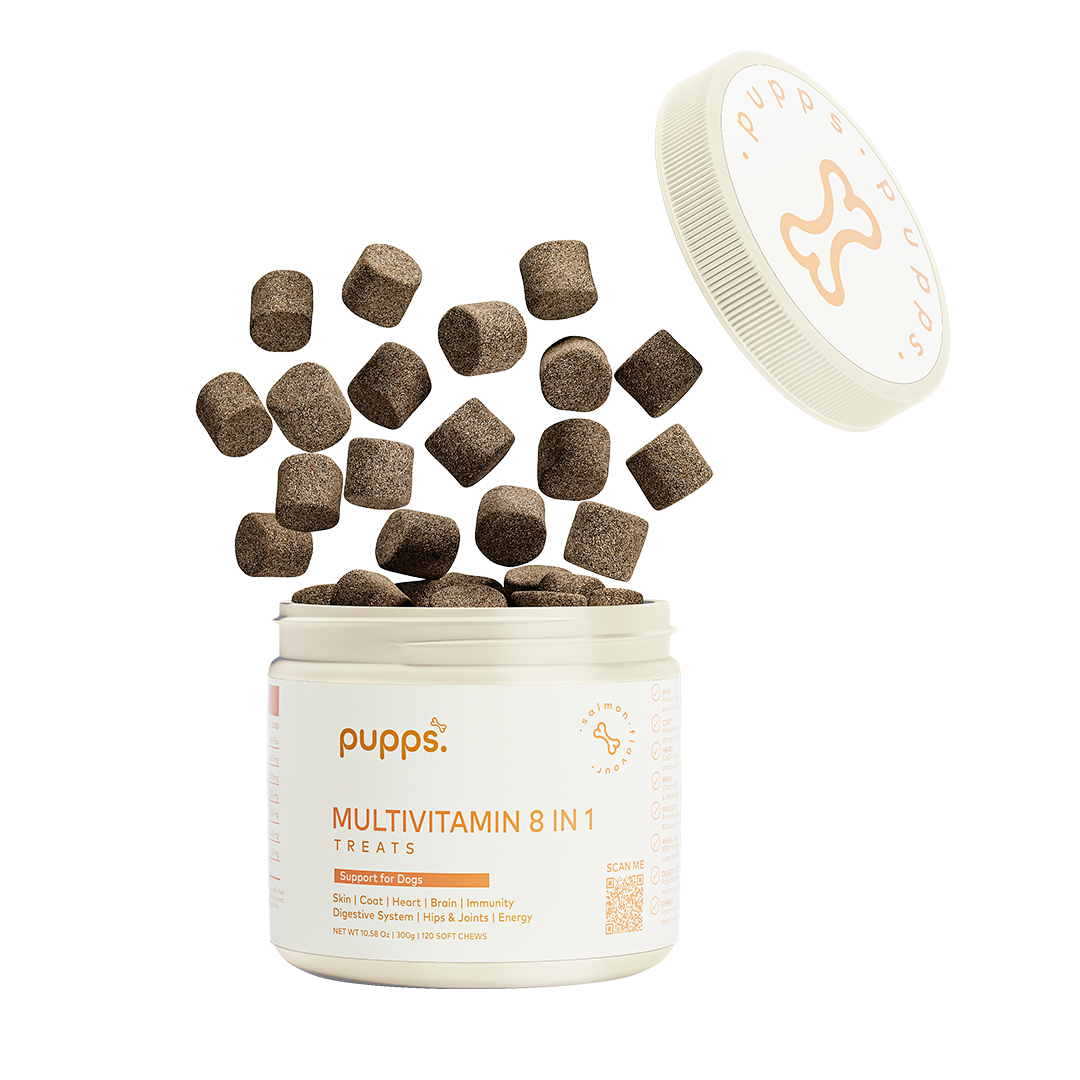
Pupps Multivitamin Treats are formulated to provide this kind of comprehensive nutritional foundation in a treat format that dogs actually enjoy. The advantage of a treat-based delivery system is consistent daily intake — dogs take them willingly, making it easy to build a reliable supplementation habit.
Can You Give Your Dog Too Many Vitamins?
This is a reasonable concern, and worth addressing. Fat-soluble vitamins — particularly vitamins A and D — can accumulate in the body if given in excessive amounts, and over-supplementation with these can cause problems. This is why it's important to choose a supplement that's specifically formulated for dogs at appropriate doses, rather than splitting human supplements.
Water-soluble vitamins (the B vitamins and vitamin C) are excreted in urine if taken in excess, so the risk profile is lower — but good formulation still matters. A reputable, purpose-made dog multivitamin like Pupps Multivitamin Treats is formulated at appropriate canine doses, so you don't need to worry about calculating amounts yourself.
If your dog is eating a complete commercial food and you're adding a multivitamin on top, you're unlikely to reach problematic levels through regular supplementation. The risks are mainly associated with giving very high doses of specific nutrients, rather than a balanced, moderate supplement.
Should You Speak to Your Vet First?
For most healthy dogs, adding a well-formulated multivitamin supplement is a safe and sensible choice, particularly if any of the signs above resonate. However, if your dog has a diagnosed health condition, is on medication, or you have specific concerns about their health, a conversation with your vet before adding any supplement is always worthwhile. They can also rule out any medical causes for the signs you've noticed.
The Bottom Line
Most dogs eating a good-quality complete food are getting the basics covered. But "the basics" isn't always the same as optimal nutrition for your individual dog, particularly at demanding life stages or in the presence of conditions that affect nutrient absorption.
The seven signs above are worth paying attention to — not as a reason to panic, but as useful information about where your dog might benefit from a little extra nutritional support. A well-formulated multivitamin, given consistently, provides a reliable nutritional safety net that can make a quiet but meaningful difference to your dog's day-to-day vitality.
Related reading
- Can I give my dog multiple supplements
- Best supplements for senior dogs
- Which Pupps treat for which problem
- What to do if your dog is always hungry
Explore the full range at pupps.com — and if you're not sure where to start, each product page explains exactly what the formulation is designed to support, making it easy to match your dog's needs to the right treat.




Leave a comment
This site is protected by hCaptcha and the hCaptcha Privacy Policy and Terms of Service apply.